

Otto Toeplitz, uno dei più grandi matematici del XX secolo, che lavorò con David Hilbert all’Università di Gottinga, invocò un cambiamento radicale nel metodo di lavoro della ricerca sulla storia della matematica: un nuovo sistema di cooperazione tra filologi e matematici, al fine di aprire le porte alla comprensione della scienza e della sua storia.
The Interdepartmental Research Center “Forms of Knowledge in the Ancient World,” established in 2013 at the University of Rome Tor Vergata, shares this goal and aims to connect different disciplines on the theme of the origin and development of scientific thought, with primary reference to Greco-Roman antiquity, but with particular attention to the Eastern and Mediterranean worlds—Arab, Indian, and Chinese cultures—whose study offers important insights for research. The Center, which since its institution has been characterized by an interdisciplinary approach, was founded by mathematicians, philosophers, and classicists and aims to make a substantial contribution to the study of ancient science and related fields, as well as its socio-historical, institutional, literary, and philosophical context, and to explore the repercussions of studies on classical antiquity in order to understand some fundamental developments in modern and contemporary science.
Institutional cooperation will allow us – this is our hope – to link different but interrelated skills, and to make their results more visible and usable, while also allowing access to a wealth of studies otherwise destined to remain largely unknown. These studies on mathematics, medicine, astronomy, geometry, music, geography, etc., will be more fruitfully carried out by connecting skills that the individual scholar can rarely master all together, and through the method of scientific research into the ancient world and its context, including the relationships between democracy and scientific progress that characterize the Hellenic West, and those between centralized power and science that we can find, for instance, in ancient China. The writing, circulation and storage of scientific knowledge in the ancient world is also one of our areas of specific focus.
The Centre will develop institutional collaborations over time with Italian and foreign centres that share similar interests in science, and is open to collaboration with anyone sharing these interests. It will produce publications and organize lectures, seminars and conferences, and will involve graduate and PhD students, stimulate scientific debate, and promote higher education and the dissemination of research results. We also plan the setting up of a small specialized library.
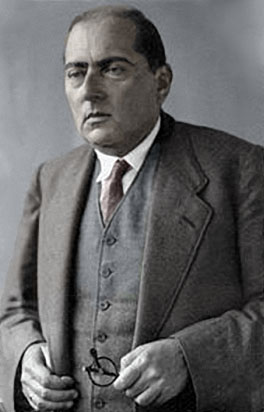
Otto Toeplitz